Internal Medicine Residency Curriculum
The Internal Medicine Residency Program at the Saint Louis University School of Medicine cultivates growth and competence by emphasizing direct patient interaction, self-reflection and meaningful feedback. The program’s mission-centered educational principle asks: “How can we create the best structure to train great internists?”
Rotations
Rotations are determined by the skills and abilities each learner should acquire at their specific stage of training — never by the clinical needs of the hospital. Program leaders are committed to ensuring a productive, positive clinical learning environment, and they use consistent feedback to optimize, amend or remove rotations that do not support their teaching mission. Resident feedback is integral to how the program improves and grows.
Residents rotation through two main hospitals:
Roughly two-thirds of rotations are at SSM Health Saint Louis University Hospital, the program's main teaching hospital.
The residency program utlizes a modified X+Y block schedule structured in six-week increments. On average, the curriculum provides an equal amount of inpatient and outpatient training, though schedules can change based on residents' practice/track preferences.
A six-week block breaks down into the following targeted experiences:
- Primary Care (One Week):
- Five half-day sessions in the Center for Specialized Medicine at SSM Health Saint Louis University Hospital
- Two half-day sessions in the PRIME Clinic at John J. Cochran Veterans Hospital
- Inpatient (Three Weeks): floors, night float, consults
- Outpatient (Two Weeks): specialty clinics, hospital discharge clinic, electives
The “Mario Kart” system is a unique rotation schedule implemented on the general medicine floors at both training hospitals and within the MICU. It’s like a modern hospitalist schedule, which involves caring for the same group of patients for eight consecutive days.
Structure
- Interns and residents are divided into five patient care teams, or “karts,” named after Mario Kart characters.
- Each team has two interns and a senior resident who remain together for the entire rotation.
- Residents follow an “8+2” schedule; they work on a care team for eight consecutive days, receive two days off, and then transition to a new care team for the next eight days.
Benefits
- Generates an average of five to six days off in a 28-day period
- Ensures two consecutive days off at one time
- Guarantees stable, team-wide daily attendance
- Allows for equal team numbers and balanced workloads
This sample schedule demonstrates how a resident moves seamlessly between teams and protected days off over four consecutive weeks at SSM Health Saint Louis University Hospital.
Week One
- Monday: Red Team (Call Day)
- Tuesday: Red Team
- Wednesday: Red Team
- Thursday: Off
- Friday: Off
- Saturday: Yellow Team (Call Day)
- Sunday: Yellow Team
Week Two
- Monday: Yellow Team
- Tuesday: Yellow Team
- Wednesday: Yellow Team
- Thursday: Yellow Team (Call Day)
- Friday: Yellow Team
- Saturday: Yellow Team
- Sunday: Off
Week Three
- Monday: Off
- Tuesday: Green Team (Call Day)
- Wednesday: Green Team
- Thursday: Green Team
- Friday: Green Team
- Saturday: Green Team
- Sunday: Green Team (Call Day)
Week Four
- Monday: Green Team
- Tuesday: Green Team
- Wednesday: Off
- Thursday: Off
- Friday: White Team (Call Day)
- Saturday: White Team
- Sunday: White Team
Elective options are flexible. All core internal medicine subspecialties (gastroenterology, hematology/oncology, etc.) as well as community-focused electives are available.
Mission-Focused Electives
- Bridge Clinic: an interprofessional clinic that provides complex care for patients discharged from the hospital who have limited access to healthcare.
- Obesity and Metabolism Clinic: a clinic that uses a multidisciplinary approach to help patients with weight loss; includes resident curriculum on the impact of nutrition on health
Popular Electives
- Addiction medicine
- Point-of-Care Ultrasound (POCUS)
- Procedure team
- Rapid response
- Radiology
- Research (longitudinal or week-based)
- Self-directed electives
- Sports medicine
- Wound care
Didactics
Residency curriculum combines structured, interactive learning with fully protected time away from clinical duties. There are four primary components:
This daily conference features a mix of topics and learning formats, including:
- Faculty lectures on core internal medicine topics
- Resident-led case conferences
- Quality and safety review
- Journal Club, an interactive review of key internal medicine articles
- "Stump the Chump," a case conference during which a master clinician dissects a presented case
- Third-year resident presentations
- Medical Jeopardy
- Grand Rounds (Fridays)
Afternoon School provides protected learning time for residents completing floor service and applicable electives. Note: On-call teams are excluded.
- Time: 3-5 p.m. every other Wednesday
- Format: highly interactive
- Topics: a variety of areas, including sepsis, ethics and career development
PCEC Morning School is a learning block reserved exclusively for residents completing the dedicated primary care week of their rotation.
- Time: Friday mornings
- Focus: outpatient primary care medicine
- Topics: case conferences, interprofessional presentations and QI discussion and implementation
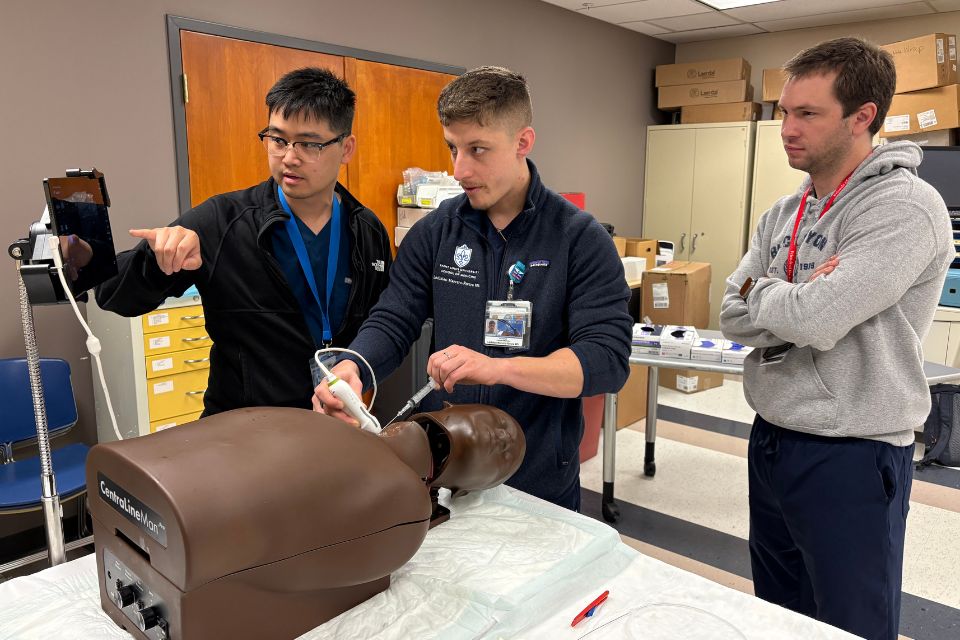
Point-of-Care Ultrasound (POCUS) provides real-time diagnostic information that complements traditional patient history and physical exams. Because POCUS has a growing importance in clinical practice, the training is now fully integrated into the residency curriculum --- a move supported by leading internal medicine societies.
Residents receive comprehensive POCUS education throughout the year, including scheduled didactic sessions, workshops with standardized patient scanning, and bedside and procedural training. All residents have the opportunity and are encouraged to pursue diagnostic POCUS and procedural certifications as part of their professional development.
Training Highlights
- Integrated training throughout residency
- Ready access to handheld and cart-based POCUS devices
- Bedside mentorship and feedback
- Resident-driven, POCUS-focused conferences
- POCUS research and quality improvement projects
- Elective rotations with the Medicine POCUS services
- POCUS certifications