2027 SLU Summit for Water
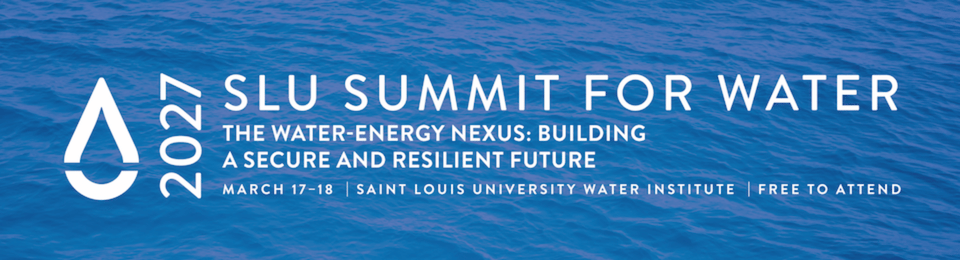
Join the SLU WATER Institute for the 2027 Summit for Water on Wednesday, March 17-18, 2027 at Saint Louis University.
The Water-Energy Nexus: Building a Secure and Resilient Future
Join leaders and experts from academia, industry, nonprofits, and government at the eighth annual SLU Summit for Water to explore the critical connections between water and energy. The first day of the summit, March 17, will focus on “The Water-Energy Nexus: Building a Secure and Resilient Future”, bringing together stakeholders across sectors and disciplines to examine growing demands on water and energy resources, discuss emerging challenges, and explore opportunities to support the long-term sustainability of both resources.
On March 18, the summit continues with a virtual day highlighting water-related research at Saint Louis University. Faculty and students will share their work across a range of disciplines, showcasing the breadth of research underway to better understand and address challenges facing our water resources.
2027 Summit Highlights
Wednesday, March 17, 2027
Location: Busch Student Center, Main Floor
Registration opens for the in-person summit. Coffee will be available to attendees.
Location: Busch Student Center Wool Ballrooms, Rooms 171-172
This panel session will explore the fundamental interdependencies between water and energy systems, including the role of water in energy production and the importance of both resources in supporting economic development and societal needs. The discussion will examine how decisions and activities in one sector influence the other, emphasizing the need to understand these interconnected systems for long-term security, sustainability, and resilience.
This panel session will explore the essential role of water in energy production, including cooling requirements for fossil fuel and nuclear power generation, hydropower, and emerging energy technologies. The discussion will examine how water availability, quality, and competing demands influence energy production, technology choices, and the planning and operation of energy systems.
More information coming soon.
Amanda Cox, Ph.D., director of the WATER Institute, will provide concluding remarks to close the summit's first day.
Location: Sinquefield Science and Engineering Center Building, Atrium (first-floor entrance).
Attendees are invited to a networking reception for light appetizers, wine, beer and non-alcoholic beverages.
The schedule for the Zoom webinar on March 18, 2026 will be announced soon.
Cost
The summit is free to attend and open to the public.
Registration
Registration for the summit will be open soon.
PDH Certificates
We will offer completion certificates to professional engineers for professional development hours for each session you attend on the day of the event. Based on Missouri guidelines, the panels and the keynote presentations will each earn one hour, and each research presentation will earn 0.5 hour. Please indicate during registration that you would like to receive PDH certificates. After the event, we will verify your attendance and follow up with the certificates in PDF format.
Unfortunately, we cannot provide certificates for those who view the recorded content after the summit.
Summit Organizers
The WATER Institute
The Water Access, Technology, Environment and Resources (WATER) Institute at Saint Louis University is an interdisciplinary research institute with the mission of advancing water innovation to serve humanity.